 For
example, when the right leg goes forward, it makes a right step, when the
left swings forward it makes a left step.
For
example, when the right leg goes forward, it makes a right step, when the
left swings forward it makes a left step.
For
example, when the right leg goes forward, it makes a right step, when the
left swings forward it makes a left step.
 When one of each of these
(right and left) has occurred, we say that the person has taken a stride,
or one gait cycle, and the time it takes for this to occur is called the
cycle
time.
When one of each of these
(right and left) has occurred, we say that the person has taken a stride,
or one gait cycle, and the time it takes for this to occur is called the
cycle
time.
 It's usual to start the cycle
with the first contact (initial contact, often called heel contact
in normal gait) of one foot, so that the end of the cycle occurs with the
next contact of the same (ipsilateral) foot.
It's usual to start the cycle
with the first contact (initial contact, often called heel contact
in normal gait) of one foot, so that the end of the cycle occurs with the
next contact of the same (ipsilateral) foot.
 If the gait is symmetrical,
then all the events on the other (contralateral) limb will
be offset by 50%, so contralateral heel contact will be at 50% cycle. Notice
that both feet are on the floor at this time.
If the gait is symmetrical,
then all the events on the other (contralateral) limb will
be offset by 50%, so contralateral heel contact will be at 50% cycle. Notice
that both feet are on the floor at this time.
 In normal walking, toe-off
(when the foot is no longer in contact with the floor) occurs at around
62% cycle.
In normal walking, toe-off
(when the foot is no longer in contact with the floor) occurs at around
62% cycle.
 When a foot (here the right)
is on the ground, that limb is said to be in
stance phase.
When a foot (here the right)
is on the ground, that limb is said to be in
stance phase.
 When it's off the ground,
it's in swing phase.
When it's off the ground,
it's in swing phase.
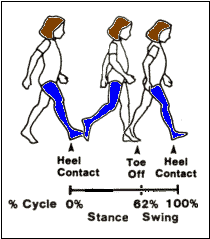 In normal walking,
each limb is in stance phase for about 62% of cycle, in swing for 38%.
In normal walking,
each limb is in stance phase for about 62% of cycle, in swing for 38%.
 Since 62 x 2 is greater than
100%, there must be a time when both feet are on the floor: double support,
which happens twice in every gait cycle (one period is split between the
end of one cycle and the start of the next), each period lasting around
12% of cycle time. In a symmetrical gait, the total double support must
be the stance time (62%) minus the swing time (38%), or 24%.
Since 62 x 2 is greater than
100%, there must be a time when both feet are on the floor: double support,
which happens twice in every gait cycle (one period is split between the
end of one cycle and the start of the next), each period lasting around
12% of cycle time. In a symmetrical gait, the total double support must
be the stance time (62%) minus the swing time (38%), or 24%.
|
|