Human Locomotion BE522: Joint Kinetics
Interpretation of Joint Moment
The (internal) joint moment is very easy to interpret - it simply tells
us which muscle group is acting at a given point in the gait cycle.
Sagittal Plane
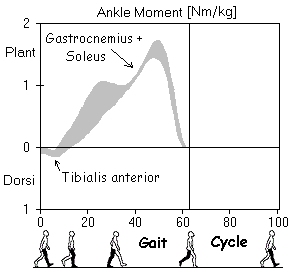 Clearly, the
dominant muscle group at the ankle is the gastrocnemius/soleus (triceps
surae). Notice that joint moment is usually normalized by dividing
by body mass. So a person of mass 70 kg would be expected to generate a
peak plantarflexor moment of 1.5 x 70, or around 100 Nm. This is quite
a big moment - equivalent to holding a 10 kg mass at arm's length!
Clearly, the
dominant muscle group at the ankle is the gastrocnemius/soleus (triceps
surae). Notice that joint moment is usually normalized by dividing
by body mass. So a person of mass 70 kg would be expected to generate a
peak plantarflexor moment of 1.5 x 70, or around 100 Nm. This is quite
a big moment - equivalent to holding a 10 kg mass at arm's length!
The dorsiflexors (mainly tibialis anterior) can be seen to be
active for only a very short time immediately after initial contact, and
the amount of moment generated is very small compared to the plantarflexors.
The purpose of this small moment is to prevent foot slap, as we will see
later.
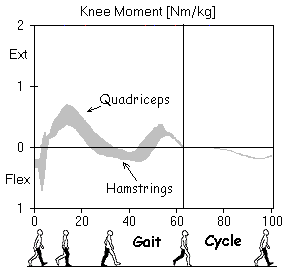 The knee moment
shows dominant activity of the extensor muscles (mainly quadriceps),
with a small amount of hamstring activity in mid stance and late swing..
The knee moment
shows dominant activity of the extensor muscles (mainly quadriceps),
with a small amount of hamstring activity in mid stance and late swing..
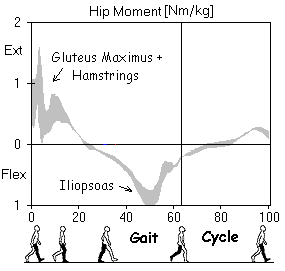 At the hip, there
are asically three phases - an initial period of extensor activity (gluteus
maximus + hamstrings) followed by iliopsoas flexor actvity, and back
to extensor again in late swing.
At the hip, there
are asically three phases - an initial period of extensor activity (gluteus
maximus + hamstrings) followed by iliopsoas flexor actvity, and back
to extensor again in late swing.
Frontal Plane
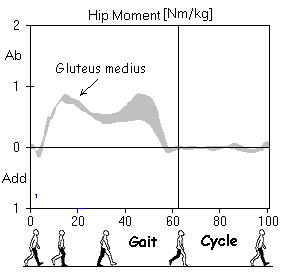 The only important
moment curve in the frontal plane is the hip. It can be seen to be almost
entirely abductor (gluteus medius). Note that during this time,
the contralateral leg is in swing phase. Without this aductor moment, the
pelvis would drop on that side (Trendelenberg
sign).
The only important
moment curve in the frontal plane is the hip. It can be seen to be almost
entirely abductor (gluteus medius). Note that during this time,
the contralateral leg is in swing phase. Without this aductor moment, the
pelvis would drop on that side (Trendelenberg
sign).
Joint Powers
The joint moment tells us which muscles are acting at any given time,
but it doesn't tell us why. For this we have to combine the joint moment
with the joint angular velocity to derive what is called the mechanical
power:
Power = Moment x Angular Velocity
P = M.w
Since both the moment and the angular velocity can be either extensor
or flexor, there are four possible conditions: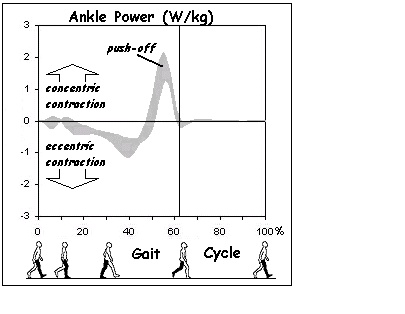
| |
Flexor Moment
|
Extensor Moment
|
|
Flexor Angular Velocity
|
Concentric
Flexors
|
Eccentric Extensors
|
|
Extensor Angular Velocity
|
Eccentric
Flexors
|
Concentric Extensors
|
A concentric contraction means that the joint is moving
in the same direction that the muscle is pulling, in other words generating
power. Conversely, in an eccentric contraction the
joint is moving in the opposite direction to the direction in which the
muscle is pulling, i.e. flexing when and extensor muscle is contracting
or extending when a flexor is contracting. The purpose of this type of
contraction is to
absorb power or, in other words, to act
as a brake on the joint.
Both types of muscle activity are used in everyday activities, including
locomotion. In general concentric activity increases speed, whereas eccentric
activity slows the body down. So (with a few exceptions) most concentric
activity occurs around toe-off, while most eccentric activity occurs
in early stance.
It should be noted that due to the somewhat illogical convention usually
used for joint moment (in which extensor moments are positive while flexor
moments are negative), the sign of the joint moment must be reversed before
calculating the power, since concentric power is positive (generation),
while eccentric is negative (absorption).
The power bursts of the muscles during normal gait have been given a
standard nomenclature by David Winter, according to the joint (H, K or
A) and timing (1, 2, 3 etc.) in the cycle.
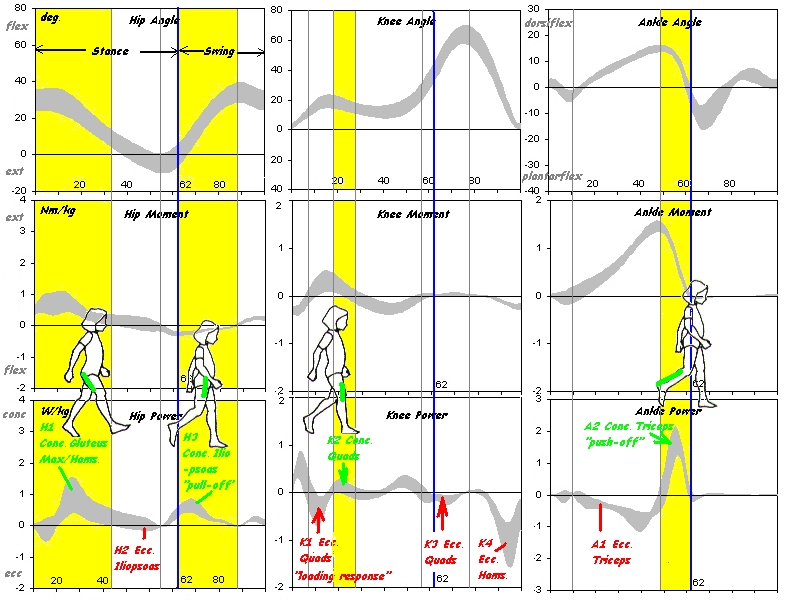
Function of the main power bursts
| |
1
|
2
|
3
|
4
|
|
Hip
|
Prevents forward motion of trunk on sudden slow-down at heel-strike
|
Control (slowing) of backward motion of thigh during stance
|
Pull-off, also prevents backward motion of trunk on sudden acceleration
at push-off
|
|
|
Knee
|
Shock absorption at knee by quadriceps
|
Small (variable) power generation during stance by quadriceps
|
Variable, but usually eccentric quadriceps action bracing the knee
during push-off
|
Hamstrings braking of shank ready for landing
|
|
Ankle
|
Shock absorption - controlling forward motion of shank on foot
|
Push-off: largest generation of power during normal gait (around
1-2 W/kg)
|
|
|
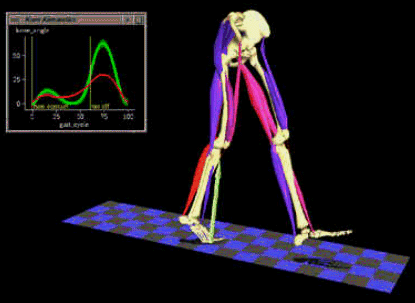
In this simulation animation, the muscles are colored according to
the power (red for concentric, blue for eccentric)