BE501 Biomaterials: Materials Science
Elastic Properties: mechanical testing
-
All (man-made & biological) materials deform when subjected to a load
-
Relationship between applied load and resultant deformation defines mechanical
properties
-
Stress = load (force) per unit area = F/A = s
(N/m2,
Pa or MPa)
-
Strain = deformation per unit length Dl/lo
= e (change in length relative to original
length, in %)
-
Young's Modulus = slope of stress-strain curve, E = s/e
(N/m2)
-
describes how springy a material is and how much elastic energy it can
store
-
materials with high Young's modulus are stiff and hard to stretch or bend
-
graph of stress vs strain (MTS or Instron machine) shows
how the material deforms:
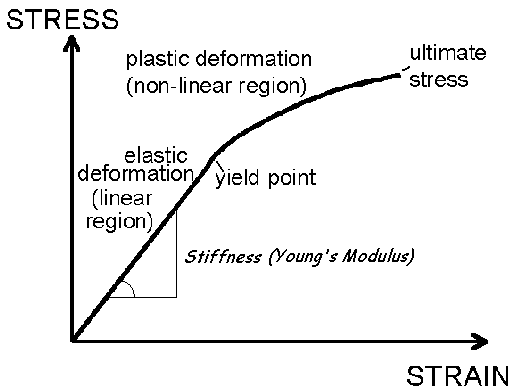
Typical stress-strain curve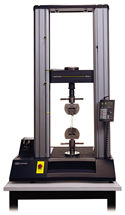
-
Initial elastic deformation in the linear region
-
removal of the applied load will result in a return to the original size
and shape
-
at yield point, the material enters the non-elastic, or plastic,
region
-
structural changes within the material begin to occur
-
results in permanent deformation
-
energy lost in the process and is not recovered when load is removed
-
finally reaches ultimate stress, when it elongates rapidly and fractures
Terms
-
Stress = Force/Cross-sectional Area (MPa)
-
Strain = Change in Length/Original length (%, microstrain)
-
Energy Absorbed = Area under the Load-Deformation Curve (J)
-
Stiffness = Slope of Load-Deformation Curve (N/m)
-
(Young's) Modulus of Elasticity = Slope of Stress-Strain Curve (MPa)
-
Strain Rate = Rate at which Specimen is Deformed (m/s)
-
Viscoelasticity = Strain Rate Dependent Properties of Biological
Tissues
-
Strength = Ultimate load of specimen OR Ultimate stress of material
-
Toughness = Energy required to break specimen or material
Types of loading
-
Compression
-
Tension
-
Shear
-
Combinations (most common in biomechanics)
-
bending
-
stress occurs on concave surface
-
tensile stress on convex surface
-
e.g. load on femoral head causes compressive stress on medial and tensile
stress on lateral shaft of femur.
-
torsion
-
e.g. at heel strike, foot pronation is associated with medial tibial rotation
|
Tissue/Material
|
Strength (Ultimate Stress)
|
Modulus
|
| Bone |
200 MPa in compression
135 MPa in tension
70 MPa in shear |
18 GPa |
| Concrete |
4.5 MPa in compression |
2.8 GPa |
| Steel |
450 MPa in tension |
20 GPa in tension |
| Wood |
3.6 MPa |
0.14 GPa |
| Tendon |
50 to 150 MPa |
1.2 to 1.8 GPa |
| Articular Cartilage |
|
1 - 10 MPa in tension
1 MPa in compression |
| Meniscus |
|
0.4 MPa in compression |
Friction
Coefficient of Friction (m) defines relationship
between frictional resistance & compressive force between surfaces.
F = m R
therefore m = F/R
where F is the shear force required to make one surface slide on another
& R the normal force pressing the surfaces together
LOW m = "slippery"
HIGH m = "rough"
|
Contact Surfaces
|
Coefficient of Friction (m
)
|
| Rubber tyre/dry
road |
1.0
|
| Metal/metal |
1.0
|
| Glass/glass |
1.0
|
| Perspex/perspex |
0.8
|
| Perspex/steel |
0.3
|
| Wood/wood |
0.25
|
| Ice/ice |
0.05
|
| Synovial joints
(Wright 1986) |
0.02
|
| Articular cartilage
with saline |
0.01
|
| Articular cartilage
with synovial fluid |
0.004
|
| Articular cartilage/articular
cartilage |
0.02 - 0.001
|
Factors affecting frictional resistance
-
relative sliding velocity (shear rate)
-
apparent bearing area
-
coefficient of viscosity
-
applied load
-
effective radius of curvature
-
lubricant thickness
-
elastic modulus of cartilage
-
pressure/viscosity coefficient for lubricant
Density
-
defines the relationship between the mass of a fluid and its volume
r = m/V
Viscosity
-
measure of friction between adjacent layers of fluid as the fluid flows
-
When a liquid is viscous there is a lack of slippiness between adjacent
layers of fluid due to "friction" between molecules of adjacent layers.
HIGH = "hard to pour" e.g. pitch
LOW = "very runny" eg. water
All surfaces, no matter how smooth they appear, are irregular
(wavy, high spots, asperities)
e.g. two sheets of coarse sandpaper in contact
Therefore, for any two surfaces in contact, apparent bearing area
or effective bearing area >>
real area of contact
This explains why, normally, frictional resistance is independent of
apparent contact area:
F = m R
Therefore, frictional force is directly proportional to the applied
load and independent of the apparent contact area
Wear
-
all artificial surfaces moving relative to each other will eventually "wear
out"
-
processes involved are physically, and chemically very complex
-
abrasion
-
adhesion
-
fatigue
-
erosion
-
corrosion
Abrasion occurs when a rough hard surface (eg. steel) slides over
a softer one (eg. plastic), or when particles are trapped between rubbing
surfaces.
Adhesive Wear occurs when local irregularities (asperities) on
opposite surfaces, "weld" together
Anatomy of a Normal Joint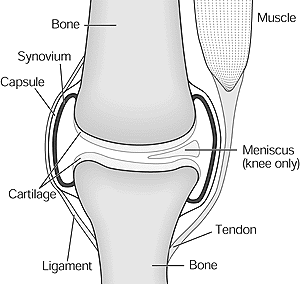
-
Bone
-
Articular cartilage
-
Synovial fluid
-
Ligament (capsule)
-
Blood supply via capsule (periarticular arterial plexuses)
-
Innervated in general by the nerves of supply to the muscles that act on
them
Degenerative changes (osteoarthrosis, OA)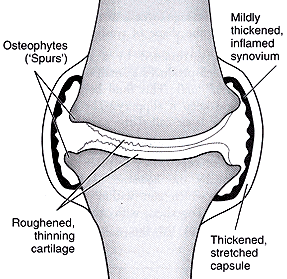
-
cartilage thinning (joint space narrowing)
-
increased wear
-
marbled bone on articular surface
-
marginal osteophytes
-
thickened capsule
Synovial Fluid Composition
-
dialysate of blood plasma filtered through semipermeable walls of blood
vessels
-
clear and almost colourless (slightly yellowish)
-
1/3 of the protein concentration of blood plasma
-
low glucose content
-
hyaluronic acid (mucopolysaccharide) produced by synovial cells
-
controls fluid content (retains water)
-
controls protein content - binds with a specific protein to form a mucoprotein
-
affects viscosity of fluid
-
small but variable cellular component (most synovial cells and connective
tissue cells removed by phagocytosis)
-
volume only 0.2 - 0.5 mL, even in large joints such as the knee: increases
with exercise
Properties
-
Thixotropic effects
-
viscosity is proportional to fluid film thickness / velocity of movement
(shear rate between articular surfaces)
-
viscosity inversely proportional to velocity gradient
-
viscosity decreases as the shear rate increases (ie. as the speed of relative
motion between the surfaces, increases)
-
faster the sliding, the more slippery is the lubrication (like. pouring
tomato sauce from a bottle)
-
Viscoelastic effects
-
acts like a gel when subjected to sudden compressive forces
-
resists 'squeezing out' from between the articulating surfaces
-
fluid deforms more easily during slower rates of deformation
-
Temperature effects
-
viscosity is inversely proportional to temperature
-
need for warm-up before physical exertion
-
Surface Properties
-
Rheology (deformation of surfaces & flow): e.g. flow
of synovial fluid within a joint
-
Tribology (lubrication, friction & wear): e.g. synovial
joint lubrication
Functions of Synovial Fluid
-
lubrication to reduce frictional resistance
-
provide nutrition to articular cartilage
-
protect the joint structures when subjected to large compressive forces
-
provide a liquid environment within a narrow pH range
-
remove various products of metabolism

Chris Kirtley